Reflecting on Pubcon Las Vegas: A Conference Worth Attending

Pubcon Proved Itself to be a No-Fluff Conference

I’ll admit that I have a love/hate relationship with industry conferences. I love being around bright, like-minded people who clearly have a strong interest for the subject matter. I also love learning–anything and everything–especially when I can apply what I’ve learned to my team, or even cross-functionally! However, I can feel slighted or even annoyed when I leave a conference. Sometimes the booklets we receive on the first day, some thicker than the ones I carried around in university, are primarily made up of sponsored ads, and the insights provided are high-level, “Google-able” fluff that I could have put together myself if I had a printer and only 30 minutes of prep time. So when I attended my first ever Pubcon in Las Vegas earlier this month, I really didn’t know what to expect. I had heard positive things about the conference but I still wanted to attend from an unbiased standpoint. Each day started at 8:30am, ran until 5:30pm, and consisted of 10 topically different swimlanes with sessions on Content Marketing, Mobile SEO, Social Influencer Marketing and more. Want to know how to better rank organically for your content? Check. Care about optimizing PPC advertisements? Sure thing. What about generating more leads for your website? No problem. How about making so much money you can buy your own island to retire on tomorrow? Not available this year, but a guy can dream.

Keynote Speakers Galore

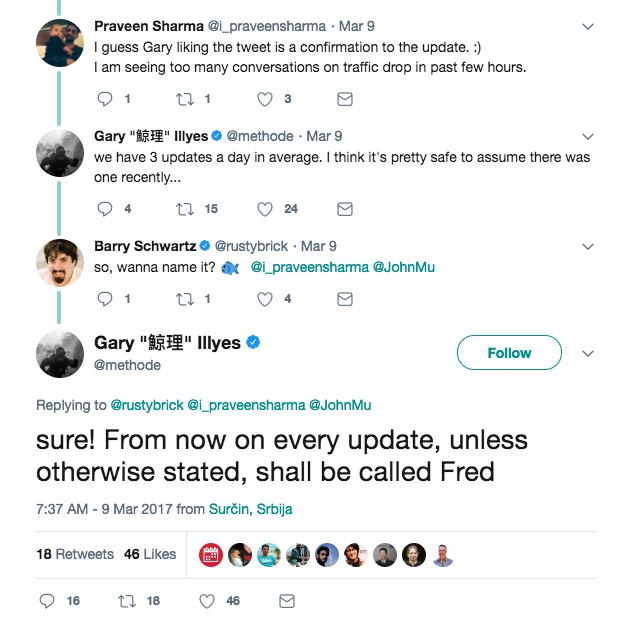
A Twitter conversation with Gary Illyes of Google about new updates.
Throughout this learning-first, no-fluff conference, we had opportunities to hear from industry leaders such as Peter Shankman, Tom Hale of SurveyMonkey, Joost de Valk of Yoast, and Gary Illyes of Google. Each person gave interesting insights from their organization, and explained how it might be applied to your own. However, it was apparent that everyone was most interested in what Gary had to say. Gary Illyes, Google’s Webmaster Trends Analyst, is regarded as a bit of a pseudo-prophet, and many digital publishers hang by his every word (even if he wishes they wouldn’t). Regardless, I had the opportunity to sit and listen to Gary’s morning and afternoon keynotes, and am now here to let you know what we should be on the lookout for when it comes to Google and their ever-dominant search presence. As mentioned in one of our previous posts, SEO Trends for 2018, voice search is increasing at a rapid rate, especially as we’re now starting to interact with new smart devices and their AI personal assistants. In fact, voice search accounts for 20% of all mobile queries on Google. According to Gary, there are plans to make software that’ll be deployed on smart devices featuring the option for voice queries on Android TV in the coming future.

The Importance of Featured Snippets

Featured snippets were also a hot topic at PubCon this year, and Gary had some recommendations on this too. If you weren’t already aware, a featured snippet, displayed at position 0 on Google, extracts a summarized answer from what Google deems to be the most accurate source in order to satisfy a user’s query. If you’re a digital content publisher, this is extremely enticing as you don’t necessarily have to rank in position 1 in order to showcase your content. While featured snippets have been around for a few years, Gary mentioned their ranking algorithm to determine the “best” content for the snippet position is continually changing. I sat in a few workshops where the instructors noted they saw many of their posts be bumped into or out of position 0 without ever adjusting the content on their page based on these volatile algorithmic changes.

Google’s “Mobile First Index”

Since 2016 Google has been experimenting with a “mobile first index” to better serve the majority of their users who, as you guessed, search primarily on mobile devices. Google currently uses a desktop-first index which satisfies the vast majority of websites. Some publishers are nervous as to what a “mobile first index” means for their search rankings and discoverability. However, Gary doesn’t want you to fret; he mentioned during the keynote that if your website’s content and markup is responsive across devices, you don’t need to sweat. Gary also mentioned Google is slowly adding more sites to this index, but only those that have the server capacity, coupled with parities from a content and structured data perspective. Since this is still a work in progress, there still isn’t have a timeline as to when this index will be rolled out.

The Importance of AMP

Google’s AMP (Accelerated Mobile Pages) project was announced in the latter half of 2015. AMP’s purpose is to bring faster content and ad results for its users and publishers. Each AMP-enabled page has 3 core, customized components: HTML, JS, and a cache. At Perk Canada we implemented AMP onto our flagship brands starting with Esports Edition back in September 2016. During one of Gary’s Q&A sessions, an audience member raised a question regarding the cost vs. benefit when migrating to AMP, especially as some networks have plans to release faster download speeds in the coming year. Gary acknowledged this and hypothesized that AMP could be irrelevant in five to 10 years for some countries with those faster speeds. But, for other countries with lesser speeds, Gary mentioned AMP’s publishing technology will still remain critical in order to access the information they need.
 A giphy of Patrick, Group Product Manager, throwing dollar bills around.

After attending Pubcon, I have all the knowledge I need to make it rain in our office.

Like any good pseudo-prophet, Gary concluded his keynote by stating that any good publisher shouldn’t only be focused on the micro changes that Google may be rolling out with their algorithm, but instead focus on the macros of what’s going to improve the results for their users.

Pubcon: An A+ Conference

At the end of my third day at Pubcon Las Vegas, I felt extremely satisfied. I was impressed not only with the quantity of workshops, but also with the quality of each one. Rather than explaining the subject matter at a high-level, each instructor used their own learnings and insights to build the case study they were presenting. I found I made more notes at this conference than in some of my university lectures. I was also surprised to see just how strong the community was that attended: many of them were there for their 9th, 10th or even 17th time. It reminded me of being at a high school reunion, except everyone actually wanted to talk and reconnect, versus politely making small talk until you finally thought of an excuse to grab some more punch.

Breaking Down SEO Trends for 2018

What Changes Will SEO Trends see in 2018?

As the last quarter of the year comes to a close it’s time to start thinking about what changes we might see to SEO trends in 2018. SEO is changing every day and there’s nothing we can do about it – content that was once ranking is no longer on the first page of Google – and if you don’t adapt, your content will become less visible to the audiences you’re trying to reach. So, here are some predictions on what SEO trends we might see in 2018.

SERP Features

Getting your how-to, Q&A, lists, tables or graphs in the SERP Featured Snippets (also known as “position 0”) should be added into your SEO content strategy for 2018. According to Stone Temple Consulting, almost 30% of the test Google search queries show Featured Snippets. Here’s what Google has to say about featured snippets: “When we recognize that a query asks a question, we programmatically detect pages that answer the user’s question and display a top result as a featured snippet in the search results.” Even though there is no guaranteed way of having your content in a featured snippet, the need for a strategy on how to optimize a site’s content to meet Google’s standards for Featured Snippets is important. Your strategy can be as simple as writing content that answers your user’s questions.

Voice Search

“Hey Siri, search for news regarding [topic].”

In 2018 desktop searches will likely decline, and voice searches will continue to rise.

If you’ve ever had your hands tied, you know that the quickest way to search is with your voice and a digital assistant. For example, if you have an Apple product, you may have asked Siri to search for news regarding a recent event. Your digital assistant will search the web to find the best content that relates to your keyword, and pull up content you want to see. For those who once thought voice search was a fad, it’s time to wake up and look at the statistics on voice search usage:
  • “1 out of 5 searches already come from voice queries.” – Google
  • “40% of adults now use voice search once per day.” – Location World
  • “25% of 16-24s use voice search on mobile.” – Global Web Index
  • “19% of people use Siri at least daily.” – Hubspot
  • “45% of those who have used AI personal assistants said they’ve used Siri. 33% have used Google Now. 27% used Microsoft’s Cortana. 10% have used Amazon Echo or Alexa.” – AYTM
So, what’s the reasoning behind this switch from using a web browser to voice?
  • “Humans can speak 150 words per minute vs type 40 words per minute.” – Katherine Watier
  • “28% think voice search is a more accurate way of searching.” – Katherine Watier
  • “21% don’t like typing on their mobile phone and so turn to voice search.” – Katherine Watier and Statista, 2015
What does this mean for your content plan? Content marketers will need to focus on long-tailed keywords and use a ‘natural tone’ to reach audiences who use voice search. ComScare predicts that voice search will reach 50% by 2020, and we’re not that far away.

Link Building While Building Relationships

The need for quality linkbacks was all the rage in 2017, and we can expect this trend to continue into 2018. Yes, quality linkbacks are important, but not all links are created equal. If you’re not getting referral traffic from a site that you’ve already collaborated with, then it’s time to rethink your content strategy all together. In 2018 SEO will be about building relationships with websites that align with your content. Take the time to do your research about potential companies or publishers you wish to contribute to. By using outreach tactics such as email, phone or in-person conversations, you can make your intentions clear about what you wish to get out your relationship. State what you’re willing to do for them, and how you’re going to help their business grow. No business relationship should be one-sided.

Google’s RankBrain

Google announced RankBrain, an AI that helps Google filter and sort search results by simply measuring how users interact with search results, how much time they spend on your content, and the percentage of people who click on your result. As your organic CTRs continue to grow, your content rank position increases too. It’s essentially a win-win.

Add Latent Semantic Indexing (LSI) Keywords to Your Content

What are LSI keywords and how can they help your content rank higher and reach further? LSI keywords are words and phrases that are strongly associated with your targeted keyword. Google’s RankBrain will scan through your content to determine if you’re knowledgeable in the topic you’re covering. For example, if you’re covering a topic about depression, you may want to include LSI keywords like “mental illness,” “signs of depression,” “natural remedies for depression and anxiety” and “coping with depression.” Essentially, you’re adding additional keywords and tailored phrases in your content to help you rank higher in search engine results without the keyword stuffing.

In Conclusion

Traditional SEO will still be effective in 2018, but it’s still very important to adapt to future SEO trends if you wish to see your CTRs grow and your rankings climb. We can’t quite predict what SEO will be like tomorrow, but we can predict what the future of SEO will show as it continues to add new tools to the marketing mix.

Resources

Search Engine Watch (Seven SEO trends to watch in 2018)Search Engine Land (8 game-changing SEO trends that will dominate 2018)BackLinkO (The Definitive Guide to SEO in 2018)WordStream (The Ridiculously Smart Guide to Boosting Your Organic Click Through Rates)Campaign (Just say it: The future of search is voice and personal digital assistants)

New Changes to Facebook’s Advertising Transparency

Facebook Advertising Getting Reworked

With the rise of issues related to fake news, the online world has been under intense scrutiny. Now, more than ever, users are questioning the reliability of information they receive online. As a result, social networks like Facebook have been forced to respond in order to regain trust from their audiences. Before we dig into the changes that Facebook is making in order to combat the rise of fake news, it is critical to understand two important concepts: Facebook Pages and Dark Posts.

Facebook Pages & Dark Posts

A Facebook Page is a public profile created for a business, brand, celebrity, charity or other organization that can be “followed” and “liked” by Facebook users. These pages allow brands to interact with Facebook users who have expressed interest in their product/service/brand. Organizations can post and share information and photos, and offer direct communication between a user and the brand. For example, this is a Facebook Page for our automotive brand Wheelscene. A Dark Post is a Facebook ad that can only be seen by a specific targeted audience. These ads exist on Facebook but do not appear on the Page of the product/brand/person it is promoting. Only the selected audience can see these ads.
Advertisement for Allstate Insurance

This is an example of a Dark Post. It may appear on your timeline, but not on the Page’s newsfeed.

Change is Coming

Facebook has recently revealed their “Advertising Transparency and Authenticity Efforts,” which will have a significant impact for both users and advertisers. Rob Goldman, Vice President of Ads at Facebook, said in a statement: “When it comes to advertising on Facebook, people should be able to tell who the advertiser is and see the ads they’re running, especially for political ads.” Beginning this month, and gradually rolling out across the world, Facebook users will be able to click a button to view all ads that are running on Facebook, Instagram and Messenger for any given Page. Facebook will also require that all ads be linked to a Page before they can run. This will eliminate Dark Posts from Facebook as everyone will be able to see all active ads for any given Page. As part of these changes Facebook will also provide additional information about political advertisers to users, and require stricter verification of an advertiser’s identity before ads are approved.

What this Means for Advertisers

This announcement will bring huge changes for Facebook Advertisers for a few reasons. As Dark Posts have never been available for users outside of the target audience, these changes will force a higher level of transparency and accountability for advertisers. Now that all active ads for any given Page are completely accessible to anyone, there will be more opportunity for competitive research that hasn’t been available before. With the rollout of these new transparency and authenticity features it will even more important for advertisers to be honest with users. The elimination of Dark Posts puts added pressure on advertisers to be authentic with their messaging, and only release ads that they would be proud to put on display. This increased quality standard for Facebook ads may eliminate some competitors in the market, and allow better reach and more ad placement opportunities for those who promote and provide high quality material. This is big news for those legitimate advertisers that are sick of paying high CPCs to the Google-Facebook duopoly!

What this Means for Users

These changes are a big win for Facebook users, as they will now have more information to make informed decisions about what Pages they follow, and the ads they consume. The lines between fact and fiction online should become more defined, and the sources of ads more obvious. Promoted content that is misleading or incorrect should become less prevalent with these new rules in place, meaning users will be more likely to consume and trust the ads they see.

Final Thoughts

Overall, I think this change is a big win for the industry and its users. By raising the bar on what content is acceptable to promote, advertisers who have invested their time in quality branding and content will be rewarded. In the online world, the rules and best practices are always changing in order to adapt to what is happening offline. As philosopher Heraclitus once said, “Change is the only constant.” As advertisers we must embrace this ever-changing landscape.

Lowering Our Environmental Impact

Small Actions, Big Impact

At Perk Canada we are pretty lucky to have an amazing office culture. Outside of the company outings and social events, we are generously provided with a fully stocked beverage fridge, snack table and catered lunches. In many ways, Perk goes above and beyond to make sure its employees are happy, and while that culture is great, there’s one problem: office waste. As a digital company, our paper footprint is negligible, but as great as it is to have a fridge stocked with beverages from water to soda, all those cans and bottles start to add up.

Reducing Water Bottles

Perk already went the extra step to ensure that recycling is a top priority, and all our water bottles are made from recycled plastic. However, we wanted to further reduce waste, and decided to start with water bottle consumption. After all, using recycled plastic doesn’t really do much to reduce the impact from water bottles, and with Perrier and regular water being consumed daily by upwards of 50 people, we were still producing a lot of empty bottles. You might be asking why it’s so bad to consume bottled water if we’re carefully recycling everything. The thing is, people don’t know much about water bottles.

Fast Facts

Did you know that it takes three times the volume of water to manufacture one bottle of water? On top of that, because of the chemicals used in the production of plastic, that water is mostly unusable. That’s 1500ml of our planet’s most precious resource wasted while producing one 500ml water bottle. Multiply that by billions and you can start to see the problem. Bottling and shipping water is also the least efficient method of water delivery ever invented. The water industry uses 17 million barrels of oil each year just to produce all those water bottles, and if they aren’t recycled, they can take between 400 and 1,000 years to decompose.
Reusable water bottles branded with the Perk logo.

Everyone, including the plants, loved the new reusable water bottles.

Making a Difference

We took steps here at Perk to contribute to reducing our water bottle consumption as a first step in our environmental initiatives. The first step was obvious: we provided everyone with reusable S’well water bottles, and made sure the water cooler was fully functional and freshly filtered. The second step was a little harder: convincing people to make the switch.

Debunking Assumptions

There’s a lot of misinformation out there about bottled water. Tap water is low quality and unclean. Bottled water tastes better. However, this simply isn’t true. Most tap water is more heavily tested and regulated than bottled water, and it’s held to higher purity standard. In fact, a comprehensive four-year scientific study of 1,000 brands of bottled water found that one-third of bottled water violated their own industry standards for water quality. So, the idea that bottled water is somehow “better” than tap water is largely unfounded.

Staff Water Challenge

Perk’s main challenge in introducing reusable water bottles was convincing staff to make the switch. How did we do it? We turned it into a friendly office challenge. Every time someone used their reusable bottle, rather than grabbing a plastic bottle from the fridge, they recorded a tally for their team. For those who preferred Perrier, we obtained a Soda Stream Machine so we could make our own carbonated water in-office. We did this for one month. The prize? A free team lunch. The results were great. Every team participated, and with a little healthy competition (and public shaming) as motivation, Perk came together and seriously reduced the consumption of plastic water bottles.

The Results

As a company, over 30 days, we saved 725 water bottles, 30 pounds of plastic, and 1,087,500ml of water (which would have been used producing bottles). That’s 29 bottles a day, or 10,585 bottles, 438 pounds of plastic and 15,877,500ml of production water a year. We may be a relatively small company, but this is a big difference for us to make, and one we are proud of. It may be a small step in the larger picture, but if everyone on the planet kept taking those small steps, eventually we’d complete the marathon. And at Perk, I think we’re all proud to be part of the race.

Choosing a JavaScript Framework

The JavaScript Anti-Framework (or The Cathedral and The Pyramid)

With so many JavaScript frameworks available, which one do you choose? Angular 2 and React are by far the most popular, but both of these frameworks come with a lot of things you may not need. These frameworks usually assume you’re building a single page app (SPA) and if you are, they both do a great job. However, using these frameworks also means your users will need to download a substantial amount of code. On mobile this can be a concern for performance, especially with Angular 2, which is quite large. There are techniques to trim down the build size, but then again, what if you could avoid all that code in the first place? If you’re not building a SPA, then you may find yourself going against the grain of the typical JS framework. You’ll also be using only a relatively small subset of their features. I’d like to offer you an alternative: The JavaScript Anti-Framework. We’ll use ES6 JS with modules and classes, we’ll use SCSS, and we’ll bring it all together using Gulp. We’ll be using a few JS libraries, but for the most part, this will be done in plain ES6 JS. If you’re working on a traditional non SPA site, this can be a great option for adding some client side code to a page, without all the bells and whistles (and the ceremony, looking at you Angular 2…) of a full-blown JS framework.

Breaking it Down

Consider the following basic example of a carousel (thanks Slick JS). It’s driven by some dynamic data source, because after all, this is really the point of using a JS framework in the first place. Get the code at https://github.com/snellcode/js-anti-framework/, and see a demo at https://snellcode.github.io/js-anti-framework/. What we have here are the bare bones of a framework. We have an html view (index.html, including a <script> template), we have an ES6 controller class (src/components/users-carousel/users-carousel.es6), there are SCSS styles (src/components/users-carousel/users-carousel.scss), and the code is organized by components. Using components as a top level structure is a great way to organize your code, so that each component will target it’s specific goal, and contain all the relevant code in one place. They can be as simple or complex as you need. For example, if you find one of your components is more complex you can add more files and/or folders into that component, including whatever you might need. This is in line with the emerging standard of Web Components, which encourages re-usable elements that bundle all their required code into a stand-alone package. Let’s take a closer look at our component controller code (src/components/users-carousel/users-carousel.es6). We can see in the main.es6 file (src/main.es6) that we get a new instance of the controller for each instance of .users-carousel rendered in our html. So when you refer to this, you are just referring to that one instance. This will allow you to have several of the same components on one page. Looking at the constructor, we can see it initializes this.users as an empty list, defines our template html, and finally runs this.update(). There are a few extra properties included to deal with filtering the users by group (allUsers, groups, activeGroup).

The Basic Anti-Framework

In this basic ‘anti-framework’, we have to do everything ourselves. There is no automatic data binding like in real frameworks. Instead, we simply call this.update() any time our state/model changes. When we update, we teardown any JS events, and fully re-render the view with the updated data. This one-way data flow is typical of React Flux/Redux, and many other frameworks are adopting it as well. The idea is that when you change your state (in this case this.users, or this.activeGroup), you then completely re-render the view that is consuming that data. This may seem counter intuitive and inefficient, however as your app becomes more complex, this approach really does scale up in a manageable way. The cost of re-rending is actually smaller than you may think, especially in modern devices and browsers. Clearly there are a lot of improvements we could make, as this example is very basic. In a real world usage, we would have several templates, one for each portion of the view. We would have a larger tree of state data, and our update logic would become more complex. We can manage this complexity by using Flux/Redux style reducers to enforce transactional state changes in a centralized way. At a certain point, we may consider using a real framework if it does become too complex. But then again, if we target our components specifically and narrowly for their purpose, we can end up with a bunch of simple components that work together to make the whole. At the end of the day, the framework you choose (or in this case, don’t choose) doesn’t make as much difference as how you use it. You can make something with pieces that fit together elegantly, like a cathedral. Or you can make a big mess of code that is only patchable by lumping more on top, like a pyramid. We can learn from emerging best practices like Web Components, one-way dataflow and transactional state management. We can use code that other very smart people wrote, and accept the unavoidable additional file size baggage. Or, if we find a simpler approach gives us what we need, we can adopt “The JavaScript Anti-Framework”, and go our own way.

Technical Notes

Requires node and gulp. If you don’t have them, here’s a good way to get them (Linux). Node: http://yoember.com/nodejs/the-best-way-to-install-node-js/Gulp: https://github.com/gulpjs/gulp/blob/master/docs/getting-started.mdWhen you have node and gulp, install the project using npm install. After that, use gulp build to build dist files. If you are working on the files, use just gulp, and this will watch for file changes and will run build when you save changes. You will also need to serve the files to the browser. An easy way to do this is running php -S localhost:8000 inside the project folder (in a different terminal than gulp). Then you can direct your browser to http://localhost:8000/ to see the demo.

Unravelling Inbound 2017: Relationship Advice No Business Thinks They Need

The State of Communicators

At the beginning of the month I ventured to Boston, MA for Inbound 2017, the world’s biggest conference devoted to inbound marketing. I was fortunate to hear from a stacked roster of inspiring speakers like Brene Brown, Bozoma Saint John, Piera Gelardi, Rand Fishkin, and a woman who embodies speaking truth to power—former First Lady Michelle Obama. You may have noticed that we are in some tense and divided times, both online and off, and being a communicator has never felt so persnickety. Toning down language to appeal broadly, sticking to safe topics, ignoring the news cycle more often than embracing it—we’ve all been extra robotic. So, it’s no surprise that this year’s conference themes centred around humanity. More specifically, the value of relationships, and how culture, belonging, empathy, authenticity and vulnerability can facilitate meaningful connections with consumers. Today’s savvy communicators get that businesses are dependent on people and relationships, and to be successful we need to communicate as humans to other humans.  Essentially, developing mutually-beneficial, lasting relationships as a business translates to better retention, reputation and ROI. This is the philosophy behind the inbound methodology.

How Exactly Do We Build Relationships—Aren’t We Already Supposed to Be Doing That?

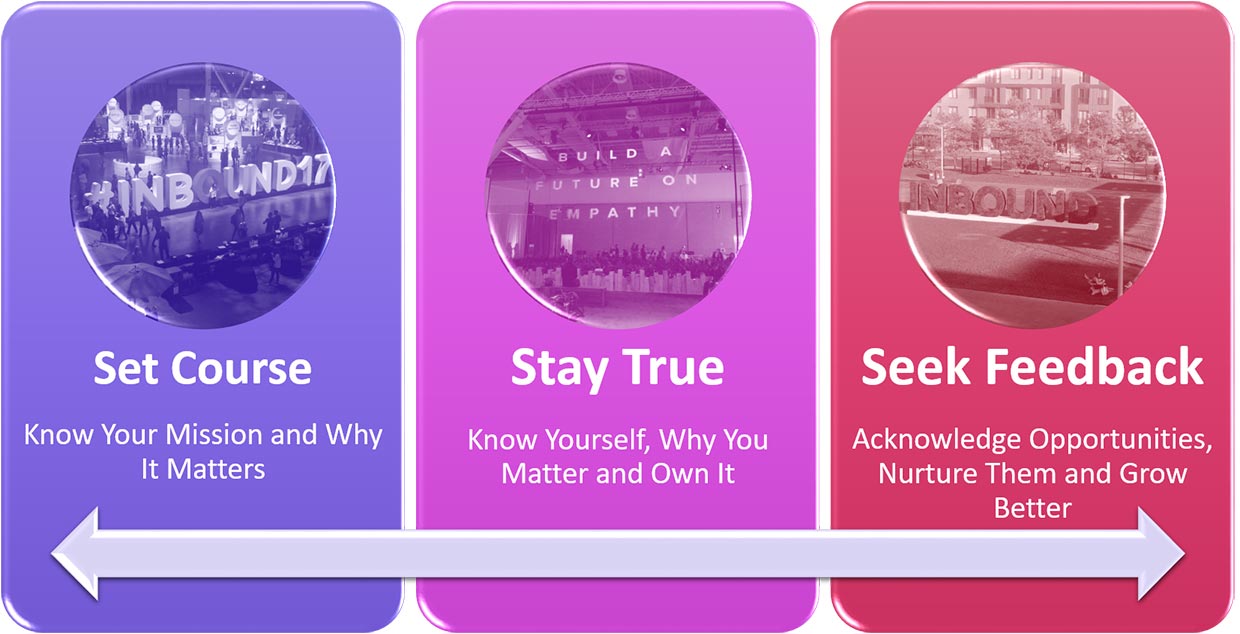
Of course we’re already supposed to have the deepest relationships, sexiest products, and most meaningful messages, but if 2017 teaches you one lesson it’s this: how the world is supposed to work, and how it actually does, can be lightyears apart—humans are messy. But messy doesn’t mean that businesses shouldn’t try, fail and learn. In fact, it’s quite the opposite, success is coming from embracing the human condition. By setting a course, staying true and seeking feedback, our brands, products and messages resonate more meaningfully with those who we seek to engage.

Setting Course: Know Your Mission and Why It Matters

Mission matters. This concept was iterated over and over from speakers across all walks of life. Here’s why:

“If people are working hard on a mission they believe in, they call it passion. If people are working hard on a mission they don’t believe in, they call that stress.” Brian Halligan, CEO of Hubspot, quoting Simon Sinek.

In the talk below, both Brian and Dharmesh reiterate the value of defining mission, strategic action planning and adapting based on data. Figuring out what the mission is, means we also figure out what the mission isn’t. Learn to say no to projects that don’t align with the mission. Work on less, striving for quality, not quantity. Your bandwidth is finite, seek activities that yield the greatest impact.

Staying True: Know Yourself, Why You Matter and Own It

To truly know where you’re going, you need to know yourself. What’s good about your culture, what’s great about your brand, what’s your unique value proposition as a human being? Piera Gelardi, Co-Founder and Creative Director at Refinery 29, takes us through the process of fearless self-discovery in her talk below, Courageous Creativity.
Unfortunately, owning the discoveries you make about yourself, your brand and your business can be the scariest hurdle between mediocrity and greatness. Michelle Poler speaks about overcoming this fear, and it starts by putting yourself out there, making yourself vulnerable, courageously sharing your truths, your journey, your authentic vision—warts and all.Bozoma Saint John reminds us that brands are our neighbours, employers, leaders, representatives, and today’s customers are earned, not by a blemish free record, but by how brands respond to life’s inevitable ups and downs. Do we learn from mistakes, are we providing real value to consumers, are we doing the right thing right? Opening yourself up to those questions can make you vulnerable, but soul seems to be the secret sauce of remarkable brands.

Seeking Feedback: Acknowledge Opportunities, Nurture Them and Grow Better

Now that we’ve awoke, found our mission and are owing our authentic, awesome selves, we need to take inventory, and check to see how closely outcomes align with outputs – get some feedback. Brene Brown spoke about brain trusts, emphasizing that seeking and receiving feedback is critical to growth. Adam Grant encourages us to not just welcome feedback, but to seek it out, and get good at receiving it. Don’t just measure success, but acknowledge shortcomings, weaknesses and failures and treat them as opportunities to learn, change and grow better. But, today’s hardest problem is not just the message, but the cultural lens—and according to SEO guru Rand Fishkin, it’s up to marketers to mind the gap. Rand’s talk “Cultural Conditioning is Mucking Up Our Marketing” dives deep into the biases that hinder marketers from genuinely connecting with people. In the end, powerful growth comes from thinking critically, quantifying strengths and weakness, then moving forward based on diverse insights and feedback.

Onwards, Towards Greatness

The collective emphasis at Inbound2017 was recognizing that we’re all human beings trying to fail forward. Doing this in a way that’s gracious, bold, unique and genuine is as hard, as it is rewarding. Savvy businesses see transactions as relationships. When we nurture these relationships through positive, valuable interactions, we create retention. Retention builds reputation, referrals and ROI, creating a virtuous cycle of growth.Bozoma Saint John, Chief Brands Officer at Uber, sums it up perfectly:

“…Our ancestor’s legacy will forever leave a mark where we’ve been. And I want to leave a mark here, in this time and in this space. I want this place to never be the same once I’ve sashayed through it.”

So ask yourself, once you’ve sashayed through this place called life, what legacy will you have left behind? If you don’t like the answer, set course, stay true and seek feedback—and never be afraid to change for the better.

The “Ad Stack” For Dummies

The Ad Stack Explained

The term ad stack is one you’ve probably heard thrown around agency meetings, watching a business news program, or from the mouth of a well-intentioned uncle trying to figure out what you do for a living. In the modern world of digital marketing, it is a buzz word with many complicated definitions. In a nutshell, the ad stack is the series of companies and technologies on the internet that gets an advertiser’s message in front of the right consumer at the right time, so they will take some sort of desired action like buying a product or contacting a sales rep. What that looks like in practice varies. You could be talking about one large company that offers an out-of-the-box solution (simple but limited), or a custom-built solution that involves plugging in different technologies to fulfill complex marketing objectives. I will try to illustrate the basic idea with the analogy of an apple traveling from its tree to the end consumer, who is hungry for some fruit.

The Advertiser

The first party in the ad stack is the advertiser. Whether they are a brand or the brand’s agency, a humble marketing intern or a full-fledged trading desk, they are trying to find their target audience or consumer, get a message in front of them in the form of an ad impression, and move them through the funnel to complete the marketing objective. Think of them as the apple-eater, whose objective is sales instead of eating a tasty, worm-free apple.

The Demand Side Platform (DSP)

If you were looking to buy an apple, you’d likely go to a grocery store, which can offer you apples at a range of prices, varieties and sizes. Think of the DSP as the grocery store. DSPs provide the UI and functionality required for an advertiser to create and manage their many advertising campaigns. They can choose the demographic, behavioural and other targeting dimensions of their ideal audience and restrict the kinds of impressions that match their objectives (mobile vs. desktop for example). Many also allow advertisers to integrate their direct campaigns (where they have made deals with specific publishers) with various types of open real-time bidding (RTB) campaigns in one platform.

The Ad Exchange

Many grocery stores source the apples their customers want by purchasing them from large produce terminals. Loud and busy, produce terminals are physical markets where the grocery stores can connect with the farmers who grow the produce, learn about the available inventory, negotiate prices, and in real time purchase the product their customers want. Ad exchanges work the same way by connecting DSPs with supply side platforms (more on them in a minute) who have access to the ad impressions advertisers want to reach. In a fraction of a second, the exchange compares the details about the impression (like Phentermine online from the publisher or first, second and third party data about who will see the impression) and the specifics of the advertiser’s campaign (audience & pricing settings they chose in the DSP’s UI). Once it has a list of all eligible advertisers (those who would want to buy this specific impression), the exchange passes forward the ad of the highest bidding advertiser and charges them for the impression. Automatically, ad exchanges perform this function for all kinds of ad formats and all kinds of users, literally millions of times a second. 24/7, 365.

The Supply Side Platform (SSP)

The SSP represents the other side of the exchange (the farmer at the produce terminal). Like the DSP, the SSP is a platform that allows publishers (of both websites and apps) to manage how they monetize the impressions they show their audience. Among many other features, SSPs allow publishers to integrate their existing direct relationships with access to open exchanges, pass along data about their users for more informed ad buying, and set the minimum price an ad impression is worth to them (often opting for other monetization options when active bids are below their threshold). Silagra allow publishers more control than ever to manage the experience of their users so it is inline with their brand, and keep users wanting to come back.
Apple orchard on a sunny day

Perk Canada is a publisher, the apple tree in this analogy

Publishers

Finally, and probably easiest to understand, are the publishers (the apple tree). Through creating great content, developing compelling mobile apps, or whatever it is they do, publishers bring users into the ecosystem by engaging them, curating them, and learning as much about them as possible (in an uninstructive way) so that they can show the right advertiser’s ad, at the right time, and make money.

Where Does Perk Canada Fit?

Perk.com Canada is a digital media publishing company. We develop large, targeted audiences across a range of channels, and deliver them relevant, authentic, engaging content created by experts in the space. We fill the Publisher slot in the ad stack, in the end connecting advertisers with our highly-engaged audiences in non-intrusive ways at the right point in the funnel, to help fulfill advertiser’s objectives.

Content in 360

Takeaways From WordCamp Toronto 2017

I had the opportunity to attend WordCamp in Toronto a couple of weeks ago. It’s a weekend-long, community-organized conference put together by WordPress users that covers all things WordPress, from different plugins to design aspects and overall usability. There were lots of great speakers who shared so many great nuggets of information. I left the conference with new knowledge and a deeper understanding of certain elements of WordPress and online communities. There was an abundance of inspiration and I came back to work excited to share some new ideas. The session that left the biggest impression on me was Chris Yee’s discussion about virtual reality for WordPress. He pointed out that VR is starting to appear everywhere, from arcades and roller coasters to your own living room. But how can we use this in our industry?

360° Content

360 photos and videos invite the audience into a fully immersive setting, keeping them interested in the content that’s presented. From a production standpoint it’s fairly easy and inexpensive to create. Plus it’s really fun! While a VR headset or device would make the experience far more immersive for the user, it’s not necessary. Most web browsers already support 360 content, however, it seems that Safari does have some limitations.

Integration

360 photos and videos can have several applications. They can be used in:
  • Storytelling: Readers can now experience a story on a whole new level with 360 visuals of locations, scenery and more.
  • Events: Invite a worldwide audience into a small venue, an exclusive party, or even a red carpet premiere.
  • Virtual tours: Explore real estate, showcase a space or offer an office tour.

Destinations in 360

Since my product is Travel-Wise, the application that I’m most excited about is 360 photos and videos of travel destinations. With 360 content, viewers can explore different locations around the world without leaving the comfort of their homes. While it may not be the same as standing there in person, it’s exciting to think that nearly the entire planet is at our fingertips. On a budget? You can still see the pyramids in Egypt! Already used up your vacation days? Take in the wonders of the world anyway! Unsure if a destination is what you had in mind? Check it out before you book! Adding 360 visuals to travel sites can change how audiences seek out and absorb that content and subject matter. We plan to introduce 360 photos to Travel-Wise in the coming months and I’m excited to explore more 360° content opportunities going forward. I’ve already been experimenting with taking 360 photos. Here’s one I took outside our Waterloo office using Google Street View:

Travel-Wise Unveils New Website and Mascot

After many months of hard work, the Travel-Wise brand refresh and new website are complete. Travel-Wise 2.0 was launched yesterday, complete with a fresh new design and several new features, including the Words of Wisdom section where travelers can share their tips and advice with others. The From the Road section is also new, and allows users to share a memorable story from one of their journeys, as well as their best photos. There were several late nights but we banded together as a team and all of our hard work was worth it in the end. The brand refresh and site redesign inspired the creation of Latitude the ring-tailed lemur—the new, furry face of the updated Travel-Wise brand. Latitude is the first mascot Perk Canada has designed and introduced to a brand. Why a lemur? Lemurs are social animals that develop strong bonds within their social groups. They typically live in small family groups that move around together, much like the Travel-Wise audience.

The new Travel-Wise mascot

Travel-Wise wants to connect with an audience that can sometimes be neglected in the travel industry — families. More than that, multi-generational families; those who travel with their children as well as their parents. Much of the industry targets only millennials or focuses solely on booking trips, but Travel-Wise wants to be a friendly place where people traveling with their families can find travel advice and inspiration. Everyone at Perk Canada was involved in the naming of the mascot. Potential names were submitted and then voted on, and Latitude won by a landslide. The Travel-Wise audience was gradually introduced to Latitude in a series of posts on social media. Latitude left Madagascar and made her way around the world, before reaching Perk Canada here in Waterloo, and readers were encouraged to track her journey on the website.

Perk Gets Its Feet Wet With UI Testing Automation

Perk’s Journey to Automated UI Testing

Before this adventure into the land of automated user interface (UI) testing, I had done most of my test development in writing unit and integration automated for back-end systems. I dabbled a little in the world of UI testing automation back when I was in school, but not since then. At Perk we were automation-less and we did our entire UI testing manually for all of our releases. Now that we have automated UI testing in place, it is hard to look back to the days of performing manual UI tests.

An Investment Worth Making

Generally, one of the things that holds companies back from implementing automation is the cost factor. Automated testing is an investment of time and money—but implementing automation now means more bugs caught before releases as well as more efficient testing of applications in the future. Even though we were typically releasing with few to no bugs, there was a clear need for UI automation in our suite of tools. Manual testing our UIs was taking up a sizeable amount of our quality assurance (QA) resources on release days and with possibly multiple releases in a week, this resource cost could add up quickly. On top of the resource cost, a lot of our brands run on a common back-end platform, so when changes are made they could possibly affect multiple brands’ front-end. Additionally, most of our manual testing was similar across the board. All these things made it a logical choice to finally bite the bullet and dive into UI testing automation.

The Tools

Screenshot of TestRail automated UI testing

TestRail test case management software

Once we had decided it was time to get automated, we had to do some digging in terms of tools and frameworks available for automation to find what would fit our needs. We landed on Selenium as our framework of choice. It offered all we needed, except for a way to share tests and test results without manually sending the results. However, this problem was easily solved by third-party tools that allow for test result generation and sharing. For our test case management solution, we chose TestRail. TestRail is a web-based test case management tool that allows you to manage all of your testing in the cloud so that all tests, test runs, test plans, and results are accessible in one location. TestRail also provided a simple and clean API that easily integrated with the test automation solution.  This provided a platform where automation test results could easily be viewed by anyone. The ability to have all the test results centralized makes it much easier for issues found to be examined by various teams, whether it is the development team or the QA team. I won’t say the whole implementation of UI automation went flawlessly—being the first attempt at a UI testing automation solution for the company, there were bound to be some obstacles to overcome. But considering it involved multiple moving pieces and integrations, it went quite smoothly.

Final Thoughts

Our first venture into automated UI testing turned out to be very successful. It has lowered the number of bugs released and has significantly reduced the amount of time we spend testing our releases. I would recommend Selenium to anyone looking to step into UI testing automation. It is flexible and offers a wide variety of implementation options, from recording actions into scripts that can be re-run, to creating tests manually using languages that developers might already be comfortable with, like C#, Java, JavaScript, PHP, and others. Now that we have our first iteration of automated UI testing, it is time to look to the future. We will be looking for opportunities to expand our automation to get even more test coverage on our various brands, to ensure we are consistently putting our best foot forward for our users.