Expanding Distribution With Browser Notifications

Are you looking to get your brand, service, or product in front of more people while developing a loyal, returning audience? Browser notifications might be your answer! At Perk.com Canada, we introduced browser notifications on Travel-Wise to increase our number of returning users to the site. Ideally, these users will spend more time on the site, view more articles, and engage with the brand as a result. This would not only increase the data and numbers for Travel-Wise, but would give us a better understanding of the user path and experience, and help us know our audience a little better.

What Are Browser Notifications?

Browser notifications, also referred to as web push notifications, are similar to the messages a user would receive from an app on their smartphone. The difference is that once a user opts-in, these clickable browser messages come from a specific website, and can be delivered to the user’s desktop in addition to an android mobile device. The opt-in permission is important because the user is allowing your notifications to interrupt their life, in a way. Email sign-ups are great, but newsletters can be ignored or lost in an inbox while browser notifications require the user to take action by either clicking through to your site, or actively dismissing the message. Therefore, it cannot be ignored. This permission-based communication does mean more responsibility from your brand when it comes to the timing and frequency of the notifications, but it also provides you with access to a loyal, VIP audience. There are some industries — such as travel, retail, and music — that are seeing higher open rates on browser notifications than email newsletters, which often results in improved user engagement.
Audience segment options for web browser notifications.

Creating segments allows you to cater information to specific audiences.

The Features

Browser notifications can be customized in several ways. When building your notification campaign, you have the option to include emojis, icons, larger images, and multiple CTAs (calls-to-action) to appeal to your audience and increase clicks. In addition to customized messages, most notification services allow you to filter your audience into segments. They can be defined by demographic information, or how they interact with your website (such as time on site or specific pages visited). This feature enables you to deliver related services, products, or information to a specific audience, which potentially increases page and site performance through targeted content. Browser notifications can be scheduled to deliver immediately, or at a specific date and time in the future. This allows you to optimize the timing for your unique audiences as well as schedule messages around specific seasons or events. Additionally, automated notifications can be triggered when a customer or user completes a certain action on your website, such as visiting a certain page. On the topic of automated notifications, there is often the option to incorporate an RSS feed as well. This can be set up to automatically notify your users whenever a new post is published on your site, without you needing to manually schedule a notification. These features vary across the different web push notification services available, so make sure you have an idea of what your goals are, and what you want to accomplish with your browser notifications, so you can find a service that will meet your needs.

What’s the Catch?

Browser notifications are relatively new so there are some downsides. Web push notifications are currently only supported by Chrome, Firefox, and Opera browsers, and unfortunately, iOS mobile devices don’t support these notifications at all due to Apple’s strict policies and guidelines. Due to their slightly more invasive nature, browser notifications rely solely on user permissions. As a result, there will likely be a smaller audience using them than you would see for a newsletter or social media platform. If you decide to try them out, be aware that there is some research and testing needed at first. Since web notifications are relatively new, there isn’t an abundance of baseline data to work from. You’ll need to continually test and monitor to establish best practices for your brand and your audience.

Getting Started

There are several third-party services that can assist you and power your notifications. We used Push Crew, but Aimtell and Leanplum are other options you can explore. It’s best to start off with a clear idea of what you’re hoping to accomplish through this direct communication with your audience. With this information in mind, you can choose what’s best for your brand by comparing features and capabilities. Nearly all of these services have customer care and support that can help guide you along the way.

The Importance of Pinterest for Publishers and Advertisers

Utilizing New Mediums

At Perk.com Canada, we’re always looking for new ways to share our content with new audiences. Utilizing traditional social media channels, such as Facebook and Twitter, are obvious choices, but for some of our brands we needed something different. Sharing high quality photos to boost content engagement was key, but what platform could we use? Enter Pinterest.

How People Use Pinterest

An example of a pin on Pinterest.

Pinterest’s visual medium allows us to share compelling content for our cosmetics brand.

To fully understand Pinterest and how it works you first need to understand what a “pin” and a “board” are. Each individual profile is comprised of a variety of “pins” that are collected and grouped into “boards” that are controlled by the profile owner. A pin on Pinterest is similar to a visual bookmark that links the user to a web page. Pinterest users can follow profiles that save content that is of interest to them; similar content will then show up on their home feed. This home feed is the heart of Pinterest. It’s where you can see pins in categories you like, pins from your friends, or pins from other profiles you follow. You can save whichever ones you like to your own boards to look at or remember later. There is also a search feed on Pinterest that allows you to search for pins on topics that match your interests.

The Case For Businesses

At Perk we leverage Pinterest for our cosmetics and beauty brand, cosmeticsandbeauty.net. Since Pinterest is a visual medium, it provides lots of opportunity for visually appealing content related to cosmetics and beauty products, which meshes perfectly with the interests of Pinterest users. Our Pinterest profile shares pins that link back to content on cosmeticsandbeauty.net. It is all categorized into boards such as skin, nails, eyes, face, and hair. This allows users to connect with our brand on a different medium, and discover meaningful content on our site. Integrating Pinterest into your marketing plan is also a good idea, as the platform has seen massive amounts of growth over the past couple of years. According to Dyani Vanderhorst, a partner public relations manager at Pinterest, “there are now more than 200 million people around the world using Pinterest each month – nearly a 40% YoY growth.”

Why Should Publishers Use Pinterest?

Publishers should use Pinterest for many reasons, as it is a completely unique platform.With over 200 million monthly active users it provides access to a large and diverse audience. The way users engage with Pinterest is also very different than other platforms. Many Pinners use Pinterest for ideas or inspiration, and are searching through pins with an open mind. This allows publishers to create intent and grab a user’s attention at the very beginning of the decision making cycle. 76 percent of Pinners use the platform to save items to purchase or use later. This unlocks a new realm of possibilities, as people will remember and cycle back to your product in the future if you make an impact. Dyani also explained how it’s getting easier for publishers to use the platform: “Pinterest is making it easier for businesses to reach their audience through new formats like Promoted Video with autoplay, ads targeted to search, Promoted App Pins, and additional measurement options with data partners. Pinterest has  also launched Pinterest Propel, a program created to support businesses and agencies new to advertising on Pinterest.”

Creating a Promoted Pin

If you have a business account, creating a promoted pin starts exactly the same way as creating a regular pin. First, you create the pin by choosing a piece of content or product you’d like to promote. Then you create a pin to visually promote it. After you have created the pin and linked it to your desired product or content, you have the option to promote the pin. The first step is to choose the objective of the campaign (awareness, website traffic, or engagement), budget, and targeting. Targeting on Pinterest is a bit different than other platforms because the user is looking more for inspiration than an actual answer to a question. Pinterest offers a few different targeting options including interests, keywords, personas, demographic, and device type. It also allows you to target based on your own data such as a customer list, or those who have previously engaged with your brand/product/content. Once the campaign goal, budget, and targeting are selected you are ready to launch the promoted pin. You might think that at this point the work is done, but it’s not. Pinterest offers analytics to help make sure your campaign is reaching your goals, so you can always review them to make changes to your campaign as needed.

Other Ways Publishers Can Advertise On Pinterest

Promoted Pins are not the only way publishers can advertise their products or content on Pinterest. Many use the platform to reach customers organically by posting organic pins and gaining page followers. The great thing about Pinterest is that it has a large network of users, and every time anyone chooses to save your content or follow your accounts page, the material you share gets sent out to an even larger network of Pinners. It is very attainable to get significant reach on Pinterest without spending a lot of money just by regularly posting useful, relevant, and actionable ideas to engage with more Pinners over time.    

The Power of Voice Assistants

“Hey Siri, can you tell me how to write a well-crafted introduction?”I’ve always been terrible at writing them since high school, and that hasn’t changed much (except I no longer have shaggy hair, and grew an additional foot taller). But, you’re not here to learn about my cringey high school years. You’re here because you have a curious mind and want to learn more about the wonders that are Voice Assistants, and their search abilities! In this post, I’ll guide you through the current applications of this technology, both inside and outside your home, and what you need to consider in order to offer a fantastic user experience for tomorrow.

Home Sweet Home

You’re probably thinking, “Patrick, this sounds cool and everything, but I really don’t see how I could use it every day at home?” Ah, okay I can appreciate your perspective. However, have you ever wondered how many teaspoons were in a tablespoon while your hands were preoccupied with cooking? What about adding ice cream to your shopping list without leaving the comfort of your couch while binge-watching Netflix? Yeah, me too. In fact, companies already offer many devices and assistants to accomplish such things. Microsoft has integrated their virtual assistant, Cortana, into Windows 10 and Xbox. Apple’s Siri has been available on iPhones since 2011, and other players such as Amazon and Google have products in this space as well.

In the Wild

Google search results displayed on a phone

Your phone will definitely know where to find the best pizza.

I recently attended PubCon in Las Vegas and listened to Gary Illyes host a few keynote lectures. He spoke to the increasing volume of voice searches being conducted on Google’s search engine, and he’s not wrong. In fact, SearchEngineLand states that voice search makes up 20% of all mobile queries.When travelling around somewhere new, you may be curious to know where you are. Through vocally searching “Where am I,” Google can display a user’s current location. If you then search for “Show me things to do here,” a listing card will display in position 0 with different local attractions. Furthermore, if you want to learn more and ask to “call X,” X being a local cafe, your smartphone will begin to call that local business listing. Through voice search, Google has been able to create a natural dialogue between their search engine and its user. Searching with voice also encourages longer queries as it’s easier to speak than type, which is especially useful since Google’s word recognition error rate is only 8%This provides better insight for marketers as the longer and more natural the query, typically the clearer the search intent. For example, if I searched for “best Montreal smoked meat,” I’d receive various results for restaurants or recipes. However, if I change my voice query to “where can I get the best smoked meat in Montreal,” I receive a card full of restaurants showcasing their finest goods, specific to that geographic location.Marketers and advertisers need to be aware of how their branded terms appear in voice search. Purna Virji conducted a fantastic experiment showcasing this with Yves Saint Laurent. Using both Siri and Cortana, she asked them to “show me Yves Saint Laurent bags,” and instead the queries presented included “show me you send the wrong bags” and “show me the song laurent bags.” Based on her findings, advertisers need to be fully aware of how their brands are being presented, and to what degree they need to account for misspelling based on mispronunciations.

Future Considerations

In November 2014, Amazon released their Alexa-powered smart speaker named Echo. Why did that matter for Amazon’s sellers and buyers? Because you now have the ability to make purchases on Amazon’s store through your own voice. That’s a huge opportunity for Amazon to increase their customer’s annual spend and purchase frequency! According to GeoMarketing, 82% of Amazon Echo owners also subscribe to Amazon Prime, and in 2013 alone, Amazon Prime members spent, on average, $1,340 each, which was more than double a non-Prime shopper.Not only does Amazon have customer loyalty working in their favour, but Echo owners also spent 10% more than they did before owning the smart speaker, and placed orders 6% more frequently. I can only imagine how many more voice assistance devices with e-commerce integrations are being developed in order to take advantage of this newly established opportunity.  With your voice data being constantly transmitted and processed, organizations need to consider the privacy and security implications of such. In November 2017, Google was found keeping copies of voice clips of searches their users had made. What was even more unsettling was that “background chatter could be enough to trigger [the] recording.” Thankfully, you’re able to sign into your Google account and delete any of the stored clippings through your settings.However, this raises a serious concern for the future of voice-powered technologies. With organizations storing potentially sensitive information on each your devices, it poses possible security breaches for everyone, from everyday users to powerful political figure heads. “Okay Google, what were my takeaways from this post?” Ah, right:
  1. Voice Assistants naturally have their place both inside and outside the home due to their natural conversing abilities with you and me
  2. As the volume of voice-driven searches continues, marketers are able to better identify user intent but need to be mindful of how their branded terms are represented
  3. Voice Assistants can play a financially lucrative role for organizations and have already proven this; however, with great power comes great responsibility, and these same organizations need to be committed to keeping our voice data secure in order to maintain brand trust and loyalty

From Top to Bottom: How Facebook’s News Feed Changes Impact Publishers

Facebook’s Updated News Feed: Publishers Need to Strategize

The recent update regarding the new Facebook News Feed feature is causing some publishers to panic, and question how to reach their audiences through the world’s largest social media platform. Facebook will begin to start showing less articles, less marketing content, and fewer ads. Yikes! That’s a significant change to the Facebook News Feed that we are all used to. So, what will users see more of now? According to an interview with Adam Mosseri, Vice President of News Feed at Facebook “the idea is to try and focus more on bringing people together by trying to put more emphasis on facilitating more meaningful interactions on social between people.” Users will begin to see more of what their friends posts: vacation photos and videos, a relative’s graduation, and events.

Why Is the Facebook News Feed Changing?

Over the past few years, Facebook has transformed itself from being a social media network to an online news outlet and advertising platform. So, why is it changing now?According to Facebook CEO, Mark Zuckerberg, the increase in articles and marketing has created an imbalance that’s “crowding out the personal moments that lead us to connect more with each other.” Based on Facebook’s research and third-party studies, he commented on how people are generally happier when they use social media to connect with people that they care about. What is not considered beneficial to one’s overall well-being is “reading articles or watching videos” that are informative or entertaining. In the past, Facebook has encountered numerous editorial issues, such as trying to remove fake news, and policing what people can and can’t publish on Facebook (and Instagram). Some users could get away with publishing misleading articles–ranging from political news to fake celebrity deaths–to explicit content that included photos and videos. For example, one incident included a Norwegian news editor who was blocked for publishing an iconic photo of a naked Vietnamese girl fleeing a village during the Vietnam War. The editorial team at Facebook found it was “difficult to create a distinction between allowing a photograph of a nude child in one instance and not others” and removed it. After receiving backlash from the community, the post was republished.

Will the Publishing Industry be Impacted by Facebook’s News Feed Changes?

Facebook News Feed example

Pages that your friends and family interact with will appear more often on your News Feed.

At the moment, it’s difficult to say if Facebook’s News Feed changes will impact the online publishing industry as a whole. Chris Nelson, Chief Operating Officer at Perk.com Canada, shared some words of wisdom regarding this question:“The short answer is, we don’t know yet. There has a been a fair bit of ‘the sky is falling’ coverage, as there typically is when an algorithmic change is announced, but it’s all speculation at this point. The reality is that organic News Feed reach has declined so significantly over the last few years that most publishers have already evolved their content distribution strategies away from complete dependence on Facebook’s News Feed. I think it’s likely that publishers who have invested heavily in a video-centric content strategy may be disappointed with the outcome, because I suspect that the ranking factors, which give preference to video, will be scaled back, and allow for other types of content that create ‘meaningful interactions’ to surface more readily. If you’re a brand who already facilitates meaningful interactions with your audience, you may be unaffected, or even come out ahead, as a result of this change”Facebook is putting less emphasis on article content on their platform, and publishers may see a dip in traffic. Now is the time for publishers to refocus their SEO efforts and work with their Google Partners to make sure their content receives attention.

How Will Facebook’s Ads Costs be Affected?

According to Mosseri, “Ads is a separate system. So in terms of this ranking change, it doesn’t apply.” Right now, it’s hard to say if Facebook Ads will cost more. Many publishers who use Facebook Ads to reach their audience on a day-to-day basis are monitoring the situation and preparing for any potential impact the changes will bring. Gwen McCloskey, Performance Marketing Specialist at Perk.com Canada, predicts:“The latest changes to Facebook’s News Feed will be a new hurdle for advertisers to overcome. Advertising costs will likely rise as businesses scramble to purchase ads to replace the lost organic exposure, along with a more limited supply of advertising placements, as friends and family posts are prioritized.”Chantal Callowhill, Digital Marketing Specialist at Perk.com Canada, predicts:“I think the change will ultimately be a good thing. Prioritizing content that is more meaningful to a user will remove some of the clutter and make room for brands who are creating and investing in high-quality content. At the beginning, News Feed space will be limited and the demand and costs will likely be high, but at the end of the day, it will all shake out as competition (from the low-quality advertisers driving up prices) starts to drop off.”

Is There a Way for Publishers to Stay in Their Audience’s News Feeds?

With Facebook’s algorithm changing, publishers will see less organic reach, less referral traffic, and less video watch time. However, there are some ways to “hack” the algorithm to work in your favor. If you read in-between the lines of what Mosseri stated with his interview at Wired, you’ll find the following:

Post That Receive More Comments Will Gain More News Feed “Spotlight” Time

“Comments are more valuable than Likes. Meaning content that inspires comments, specifically, long comments which actually take time and thought to type out will be a positive ranking signal for the algorithm which will lead to increased distribution of the content which sparked the lengthy response.”

The New Update Will Focus on Long Comments vs. Short Comments

“We find regularly that if you take the time to actually write a more thoughtful perspective on something that correlates positively with a comment that someone actually would respond to or Like.”

Facebook Groups Posts Will Appear More in News Feeds

Facebook groups are known to be full of meaningful conversation between users from around the globe, and are becoming “increasingly active and vibrant. It’s possible to expect that content and discussions that are posted to Facebook groups will receive more distribution in the News Feed following the update.

Content That is Talked About and Shared Will be Distributed More

“News content that is more directly consumed by users – that they don’t actually talk about or share – will actually receive less distribution as a result.”

The TL;DR:

  • Comments > Likes
  • Long comments > Short comments
  • Content from groups > Content published on your page
  • Content that generates comments > Content that generates Likes
  • Content that is talked about > Content that is seen but isn’t interacted with

Actionable Steps You Can Take to Stay in Your Audience’s News Feed

If there’s anything to take away from this, it’s that you need to rethink your Facebook strategy and find new avenues to get into your audience’s News Feed, from creating “share-worthy” to conversation-driven content that’s more than just a tag and a Like.

Promote the “See First” Feature

Facebook launched a “See First” feature in June of 2015. Essentially, this feature allows users to specifically see content from friends and pages at the top of their News Feeds. Teaching your users to select the “See First” feature on your pages before the update is implemented should be done right away, via video or a photo.

Implement a Facebook Groups Strategy into Your Facebook Marketing Plan

One of the most valuable tips I mentioned in our 7 Easy Ways to Increase Facebook Engagement Organically post included the use of Facebook groups. Curate a list of Facebook groups that align with your brand’s persona–from their likes to interests and characteristics–and then focus on the quality of the group. For example, how many users does it have? How do they interact with posts? Is there a lot of conversation going on? Using Facebook groups will give you an edge over any competition, and get your content out there without you having to spend a dime.

Utilize Facebook Advertising

Instead of posting every single piece of content you own, publishers will have to think more strategic about the type of content they post. Publishers will need to focus on promoting meaningful interactions among their audiences in order to be prioritized in the News Feed.

Looking Ahead

With these new changes coming into effect soon, publishers will need to use a few different methods in order to ensure their content is visible on their audience’s News Feed:
  • Encourage interactions on their social media platforms
  • Produce and publish content that will ignite conversations among users
  • Engage within multiple Facebook groups
  • Use Facebook advertisements
  • Show their audiences how to see their page’s content first in the News Feed

Esports Edition Launches Partnership with AnyKey

Fostering Inclusiveness in Esports Communities

Esports Edition, one of Perk.com Canada’s major brands, recently launched a new partnership with AnyKey, an “advocacy organization dedicated to supporting diverse participation in esports.” Why is this noteworthy? Well, anyone who has ever played a game online can tell you that online gaming communities aren’t always the nicest. Yes, they are often spaces filled with friends and team-building games, but they are also rife with toxic trolls, name-calling, and offensive language that is just downright unacceptable. Esports Edition has always operated under a strict code of ethics that ensures players of all levels, regardless of who they are, are welcome and respected. That’s also what AnyKey strives to do.Gillian Linscott, Esport Edition’s Community Manager, reached out to AnyKey in 2017 to see if there was any potential to work together. The fact that both organizations focus on building inclusive communities was too good to pass up on.

We’re (Kind of) a Big Deal

Esports Edition is the first and only media group to join the affiliate program. Becoming part of AnyKey’s affiliate program proves that we are not only a go-to news source for fans and players, but that we are also dedicated to creating an online gaming community that is harassment-free. Toxic behaviour and comments won’t be accepted, period. “I wanted Esports Edition to take a stance on important issues in the gaming community, such as online harassment and inclusivity,” Gillian explained. “If you go through AnyKey’s affiliates, you’ll notice that there’s no media organization on the list. The absence of media organizations demonstrates the unwillingness that some of the most prominent voices in the gaming community have to committing to social change.” “Our role as journalists should go beyond simply delivering the news to fans,” she continued. It’s incredibly exciting to be the first media organization that AnyKey has accepted.

Supporting Each Other

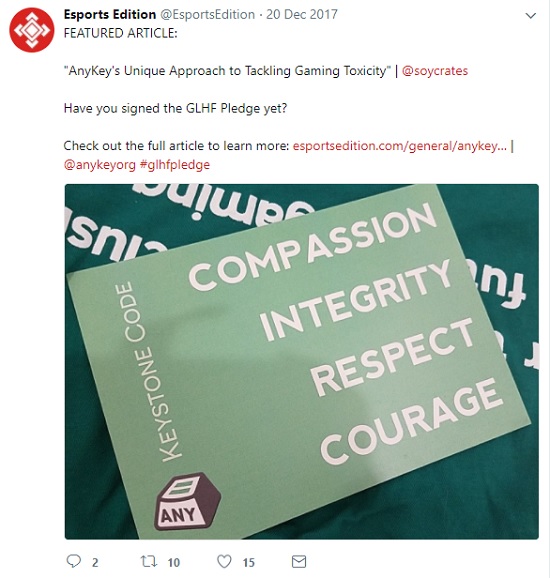
Tweet of Esports Edition's first AnyKey article
This new partnership means that Esports Edition and AnyKey will be working together on a number of upcoming projects. First and foremost, we’re collaborating on raising awareness of each other. Esports Edition will soon be listed as an affiliate on AnyKey’s website, and AnyKey will be featured as an active partner on Esports Edition’s website. Spotlight articles are also being written by some of Esports Edition’s staff writers, and shared through both organizations’ social media channels. The first article, AnyKey’s Unique Approach to Tackling Gaming Toxicity, was published last month, and highlighted AnyKey’s successful GLHF pledge. This pledge, which was created in collaboration with Twitch, has had over 250,000 participants to date. It’s also a call to action that Esports Edition fully supports, as everyone should be able to enjoy online gaming without having to deal with toxic teammates. Over the next couple of months, Esports Edition will also have the opportunity to interview and write spotlight articles on three other notable organizations within the esports community: Anxiety Gaming, GaymerX, and DeafGamersTV. These stories will not only highlight some of the amazing work being done in the gaming community, but also allow Esports Edition to expand and work with new companies and organizations.

What’s Next?

While this new relationship with AnyKey is a success in itself, it’s not ending there; this is only the beginning. Esports Edition’s new affiliate status will open new doors, and allow us to expand our reach, cover new topics, and help foster positive changes within the esports industry and online gaming communities. “I wanted to set an industry standard that said ‘to be a successful media organization you don’t have to sacrifice ethics or morals to get clicks,’” explained Gillian. And she’s right. Moving forward, Esports Edition is hoping to create a joint series with AnyKey that focuses on creating more awareness of minority groups, and becoming a voice for change in the community.

LSI Keywords: The Key to Increasing Organic Impressions, Ranking, Clicks and CTRs

Can Latent Semantic Indexing Keywords Really Improve Your Organic SEO?

The answer to this question is yes! Latent Semantic Indexing keywords (LSI keywords) can instantly give your content that extra boost in organic reach while allowing search engine crawlers to better understand your primary keyword topic.

What Are LSI Keywords?

LSI keywords are words that are related to your focus keyword. These keywords are words (or phrases) that group together with other words because they share a similar context. Think of LSI keywords just as keyword variations of your primary keyword.

How Do LSI Keywords Improve SEO?

Here are a few ways that LSI keywords can improve your SEO:
  • Search engines are now looking at total context rather than keyword density. This means your page will rank higher for your main keyword because search engine crawlers understand the context of your page better.
  • They give you a chance to calm down on keyword density, as additional repetitions of your primary keyword can put you at risk of a Google penalty. By using LSI keywords, you can safely keep adding these closely related keywords into your content.
  • LSI keywords are related to your main keyword, and are therefore considered to be keyword variations. That means your page is going to come up in the search results for your main keyword and for those keyword variations.
  • Is Keyword Density No Longer a Good SEO Strategy?

    Yes and no. You don’t want your keyword density to be too low or too high. Google considers articles that have a high keyword density to be “spammy,” and will penalize these sites, as they are considered as having poor content. This is where LSI keywords come into play. You’ll want to keep your keyword density to 0.8% and LSI keywords to 2.8% so a) you won’t get penalized and b) you can increase your own SEO.

    How to Find LSI Keywords

    There are numerous free and paid tools for finding LSI keywords. My personal favourites, which help myself and the content team at Perk, are LSIgraph.com and Google’s “searches related to” results (which you can find at the bottom of the SERP). These tools allow you to assess what type of content your users are looking for in addition to the focus keyword.
    Screenshot of different keywords related to "cars."

    Examples of LSI keywords for “cars.”

    For example, let’s say your primary keyword is cars. The LSI keyword that relate to cars can be about any of the topics below:
  • Cars – vehicles (new, used, pre-owned, dealership etc.)
  • Cars – the animated Disney film (characters, soundtrack, Walt Disney, etc.)
  • The Cars – an American rock band (music, rock, rock n’ roll, songs, etc.)
  • By including the LSI keywords, search engine crawlers will better understand what you’re trying to cover, and what you’re trying not to cover.

    How to Use LSI Keywords in Your Content

    Now that you have a better understanding of what LSI keywords are and how to find them, it’s time to start implementing them in to your content to help improve your content’s SEO and organic ranking. Where can you place LSI keywords?
  • The page title
  • H1 and H2 tags
  • URL address
  • Meta tags
  • Images alt text
  • First paragraph of text
  • Body of content
  • Links anchor texts
  • Last paragraph of text
  • The Takeaway

    If you’re not sure where to implement LSI keywords as you’re creating content, it’s best to save that part for last. Focus on creating content for your audience first, and then think about SEO, keyword density, and how you’re going to implement LSI keywords within your content.

    7 Easy Ways to Increase Facebook Engagement Organically

    How to Increase Facebook Engagement

    “Engagement” is a buzzword we often hear in the marketing world, but what does post engagement mean on Facebook? According to Facebook, post engagement is measured by the number of users who interact with your posts. This can be from reactions, comments, shares, viewing your photo or video, and clicking on your link. Facebook engagement is crucial for any social media marketing strategy, especially if you want to reach audiences far and wide without paying a dime to get people onto your website. All you’ll need to do is tweak your social media strategy with these seven effective tips to increase Facebook engagement today.

    1. Posting Times and Frequency

    Although Facebook’s algorithm has changed a lot in previous years, making it hard for brands to appear on user’s News Feeds, there are still ways to hack it by posting at the right time and keeping a consistent frequency. With a little planning and some research, you can easily interact with your audience based on their peak engagement times, and which days they tend to interact with posts. Associate Product Manager of NewLifeOutlook, Alyssa Winegarden, explains: “Every community is made up of unique users and demographics. Instead of utilizing times that may be the most active for Facebook in general, refer to your page’s Insights to see what days and times your users are most active, and schedule posts according to that. I personally try to schedule approximately 20 minutes prior to peak times to ensure the post is already in their news feed when they sign on and begin to scroll.”
    Screenshot of a NewLifeOutlook Facebook post.

    Audiences across our NewLifeOutlook Facebook pages consistently engage with posts that include visual content.

    2. Share User Valuable Content With an Enticing Message

    Do you create content that speaks to your users, and if so, are you sharing it? How are your users engaging with it? Are you getting the engagement you want to see? If you’re noticing certain posts get more attention than others, then it might be time to rethink what exactly you’re sharing. So, how do you select a piece of content that’s worth sharing? Ask yourself these four questions:
    1. Does it solve a problem?
    2. Is it actionable?
    3. Does it relate to your audience specific needs?
    4. Is it time-sensitive?
    If your answers are ‘yes’ then you’ve got some great content to share. If not, tweak your content until it becomes meaningful.

    3. Learn From Your Successes and Failures

    Life is about constantly learning from both your mistakes and successes. What may have been a good idea might not have exactly paid off in the way you thought it would. This is the main reason why tracking your post performance matters. Reading between the lines of your post’s data is an easy way to see what worked and what didn’t. For example, perhaps your post was too long, or you didn’t include any visuals, which may have caused your engagement to drop. Or maybe you hosted a Facebook Live event and the engagement you received was phenomenal. Analyzing your data might take a few extra minutes of work each week, but is one of the easiest ways to see how your content is performing, and what improvements can be made to achieve your goals.

    4. People Love Visuals

    Videos and photos have been consistently populating Facebook News Feeds for over the past five years because of how eye-catching and attention-grabbing they are. According to a Buzzsumo study, an analysis of more than 100 million Facebook updates over a three-month period revealed that Facebook posts that used images received 2.3 times more engagement than those without. Natasha Devine, Associate Product Manager of Travel-Wise, says: “Image posts on Facebook, like our shareable travel quotes, see a 50% higher engagement rate on average than link posts. Bright, inspiring visuals seem to connect with the audience and invite more interaction.”
    Screenshot of a post on our Travel-Wise Facebook page.

    Images of travel destinations always do well on our Travel-Wise accounts.

    5. Keep It Concise

    Did you know that Facebook’s character limit supports up to 60,000 characters? Realistically, you should be using a fraction of that to send your message out. So what exactly makes the perfect Facebook post? Digital Content Coordinator of Travel-Wise, Marissa Evans, says: “You don’t want it to be so short that people don’t have any idea of what the article is about, but you also don’t want it to be so long that people feel like they already have all of the information they need from the blurb. They need incentive to click on the post to find out more about the topic. 40 characters is just enough to draw them in.”

    6. Get Involved in the Facebook Community

    Go beyond your Facebook page and get involved in Facebook groups. This is another conventional way to drive engagement back to your page. Facebook defines groups as a “place for small group communication and for people to share their common interests and express their opinion. Groups allow people to come together around a common cause, issue or activity to organize, express objectives, discuss issues, post photos and share related content.” In these Facebook groups, you’ll want to be active and engage with other members while self-promoting your page or your website, just don’t look too spammy or else you might be removed from the group, and your content could be deleted.

    7. A Call to Action That Clicks

    Don’t underestimate the effectiveness of a good call to action (CTA) on Facebook. By using the right words you could actually see an increase in both Facebook engagement and reach. According to a report by TrackMaven, the average engagement rate of posts which used the terms “share,” “please,” “now,” and “like” received more engagement than those that didn’t. Lizz DiCesare, Digital Content Manager at Perk Canada, says:“If people are passionate about your cause or product, they will want to support it. A call to action is a simple and effective way of allowing your audience to engage with your company, and show their support.”It’s as simple as that. After applying these easy tips to your social media marketing strategy, you can expect more organic engagement on Facebook, and crush your 2018 goals.

    Resources

    TrackMaven (The Marketing Maven’s Guide to Facebook)Buzzsumo (How to Massively Boost Your Blog Traffic With These 5 Awesome Image Stats)Buffer (Inside the Facebook Algorithm: All the Updates You Need to Know)

    Perk Gives Back for the Holidays

    Office Campaign Focused on Giving Back

    Located in the heart of Kitchener-Waterloo, Perk.com Canada is lucky to be part of one of the most up-and-coming tech communities in Canada. We’ve done a lot over the past few years to make ourselves known in the community, from attending networking events to hosting job fairs, and more. We have been lucky to meet and work with many amazing people, and learn a lot about the region’s growing tech hub. While it is important for us to participate in our local tech-community—we love networking and sharing our industry knowledge—it is equally as important for us to give back to our larger community, and ensure that KW continues to be an amazing place for everyone who calls it home. We take our social responsibility seriously. We decided that the holidays provided the perfect excuse to spread a little cheer, and give back to our KW neighbours. This year we decided to focus our efforts on two charities: The KW Sertoma Club and StuffIn Stockings.

    The KW Sertoma Club

    Christmas stockings filled with stocking stuffers.

    Our office filled over 15 stockings to donate to local charities.

    Perk has had a relationship with The KW Sertoma Club for the past few years. They run a holiday campaign every year called Christmas Miracle, which focuses on distributing holiday gifts to underprivileged children in our community. For many, these gifts are the only ones they will receive. This year, Perk made a financial donation to The KW Sertoma Club, which helped its Christmas Miracle campaign reach more children. We were happy to have had the opportunity to give back to this great cause.

    StuffIn Stockings

    This was the first year we worked with StuffIn Stockings. They focus on delivering stockings to children in our community, which helps provide a sense of excitement and joy on Christmas morning. Our office divided into five teams, and each team was responsible for stuffing stockings for a specific age range. The ages we covered were infants (0-1), toddlers (1-3), early years/school aged children (4-12), teenagers/young adults (18- early 20s), and seniors. The stockings were filled with essentials, as well as fun items we thought people would enjoy. The money used to purchase stockings, and the items inside, was raised at our annual holiday party through a ticket raffle. At the end of our office campaign, we ended up stuffing over 15 stockings, which have since been given to StuffIn Stockings, and will be distributed throughout our community. As we continue to grow and expand in Kitchener-Waterloo, we will also continue to give back to our amazing community: we take great pride in helping others. There’s no better feeling than knowing we helped make someone’s holiday a little more enjoyable.

    Chatbots 101

    Developing Perk’s First Chatbot

    I took on the role of Associate Product Manager for NewLifeOutlook earlier this year. One of my goals for our third quarter was to build a chatbot for one of our Facebook pages. (Chatbots used specifically on the Facebook Messenger Platform are often referred to as Messenger Bots.) At the time, chatbots were fairly new, and Perk hadn’t made one yet. I assumed that this project, like our browser extension and websites, would be built by one of our developers. However, one of the great things about working at Perk is the opportunity to get your hands dirty and develop new skills. When our third quarter was looming and it became apparent that the task of creating our first chatbot was about to fall into my lap and become my virtual baby, I was both excited and intimidated. As someone who hasn’t built anything more complicated than a gingerbread house, I was nervous at the thought of having to create one of those techie doo-dads that appeared to be complex and out of my comfort zone. But I successfully got through the project, and am now ready to share some things I learned along the way.

    Breaking Down Chatbots

    A chatbot essentially automates conversations with users, so you don’t have to spend time manually replying to everyone. They are commonly used on Facebook Messenger; you may have seen the ‘Get Started’ prompt pop up on Facebook when you visit a page, or try to start a conversation with a business. These chatbots allow users to interact with your brand and receive answers to questions, or shortcuts to popular inquiries. For example, if you run a restaurant, setting up an AI rule in Chatfuel would allow your users to automatically receive a link to your menu whenever they ask for it, instead of you having to manually reply with a link each time someone wants to order takeout or see if your restaurant has vegan options. While chatbots are commonly found on Facebook, they can also be integrated into your website for customer service inquiries. Many of the plugins that are available via Chatfuel can also be integrated into your website.
    Screenshots of a conversation with a Facebook Messenger bot.

    Our chatbot interacts with our NLO Bipolar Disorder Facebook page.

    For our health brand, NewLifeOutlook, I created a chatbot specifically for Facebook Messenger. I set custom queries that would pull relevant resources for those with Bipolar Disorder. For example, if a user types in a query that would indicate they are thinking of self harm, they will be given a list of crisis helplines.

    How to Create a Chatbot

    Chatbots can be built by anyone (if I can do it, you can do it!), using third party tools such as Chatfuel, which is specifically for Facebook Messenger bots, or Botsify. Alternatively, if you have a stellar dev team, the opportunity to build your own chatbot is also a possibility. It’s important to note that while Chatfuel is user-friendly and has a plethora of online resources, including an incredibly helpful Facebook community, utilizing a third-party tool does run the risk of keeping you confined to its limitations. This is where DIY-ing a chatbot would come in handy. Another thing to note: it’s expensive. Chatfuel’s payment model is based on the number of ‘reachable users,’ which means you pay based on potential, and not necessarily the number of people who engage with your chatbot. Because of this, going the ‘build your own’ route may be the better option long-term.

    Why Build One?

    There are several reasons why you should consider building a chatbot:
    1. Your chatbot can act as a simplistic way for your users to find information or read your content, which boosts brand loyalty.
    2. Your chatbot can directly notify your subscribers whenever there’s a new piece of content available, which leads to increased organic traffic.
    3. Your chatbot can free up resources by automating interactions and replies to user messages, so you don’t have to.
    4. Your chatbot can provide transactional information, such as order or shipping notifications.
    Creating a chatbot will have positive impacts on both you and your audience. For YouChatbots are great for many industries, from e-commerce businesses to restaurants, news sources to realtors, and more. The ability to customize your user-experience, to serve new content as it becomes available, and keep a consumer engaged is universal no matter which industry you belong to. You have an audience, so use it to your advantage! For Your CommunityChatbots aren’t just beneficial to your brand, they’re also beneficial to your community. No one likes to wait around for a business to get back to their message, particularly if it’s for a simple inquiry. Chatbots allow interaction with your audience automatically, which makes your response time immediate. I hope this post has helped educate you further on the benefits of chatbots, and perhaps inspired you to conduct some additional research to see if one would be right for your brand. If you want to check out our chatbot, you can find it on the NewLifeOutlook Bipolar Disorder page.

    Travel-Wise Introduces Two New Features

    Boosting User Engagement

    With the launch of Travel-Wise 2.0 in early October came the advent of two new and exciting features on the website: From the Road and Words of Wisdom. Both provide ways for our community to get engaged and share their personal travel experiences.From the Road invites people to share memorable moments from their travels through both words and photos. We then use this content to create a post that features their narrative and photos so other travelers can read about their experience.
    Traveling Tip: Always check the seat pocket to be sure you don't leave any important items on the plane.

    Here’s an example of a Words of Wisdom post.

    While From the Road involves a full anecdote, Words of Wisdom is intended to be an opportunity for our community members to share a small snippet of advice they have gleaned from their travels. They can also submit one photo along with their tip, which will appear in a slider gallery on the sidebar of articles on the website, and on a category page.

    Community Building

    It was important to us that we engaged with our audience in different ways, rather than simply relying on social media. We built this beautiful new website, so in what ways could we get our audience to interact directly with it, instead of just on our social platforms? In response to this query, Natasha Devine, the associate product manager for Travel-Wise, developed the ideas for both From the Road and Words of Wisdom. From the Road was born from similar features on NewLifeOutlook and WheelScene, which proved successful in building engaged audiences. Creating a space for people to share their travel experiences would also address a gap for many travelers: not everyone has a travel blog, but everyone loves to share stories about their trips. The idea for Words of Wisdom was to create a feature that people could more easily contribute to than From the Road. People find firsthand travel experience valuable, and while our writers have a diverse set of travel experiences, they can’t possibly cover everything. As such, this feature allows us to present a greater diversity of travel experiences on the website, and highlight niche areas we wouldn’t otherwise have thought to cover. Not only do these features allow our audience to get involved, and thus feel a connection to the website, they also allow users to learn from one another. This adds value to our site, and reinforces it as a resource for our audience of travelers. If our users know they can visit our website and get advice or hear stories from likeminded travelers, they will continue to come back, and even share content with their friends and family. Hearing from our community in such a direct way also helps us to know our audience so we can better cater to their interests and travel style.

    A Visual Experience

    A screenshot of the Words of Wisdom page on the Travel-Wise website.

    Anyone can submit travel advice and participate in Words of Wisdom.

    One of the main goals of Travel-Wise 2.0 was to make the site more visually appealing, since images are a key aspect of the travel industry. Nothing gets people more excited about travel than a high-quality image of an incredible destination. In order to meet these expectations Natasha ensured both features would have a visual aspect to them. People are able to submit their own photos, which are then used as a main design feature. This also works towards lending greater authenticity to the website, because these are real photos from real trips taken by real travelers who use our website. Not only do these photos serve as a draw for people to click on From the Road and Words of Wisdom submissions, they incentivize people to complete their own submissions because they know their images will have a place of prominence on the website. Essentially, we are getting our users involved in building the kind of website they want to see and use.